Airspace · Sovereignty · Corridors
Airspace as Territory
Why the Sky Is Governed Before It Is Crossed
On the morning of 5 June 2017, the operational map at Qatar Airways headquarters stopped describing the world outside.
Routes that had carried aircraft from Doha only hours earlier were disappearing from the system. Departures remained scheduled, crews were reporting for duty and passengers were arriving at the airport, but every flight now depended on a sky that no longer existed on the same terms.
During the night, Saudi Arabia, the United Arab Emirates, Bahrain and Egypt had closed their airspace to Qatari-registered aircraft.
No border had moved on the ground.
Above it, four sovereign decisions had changed the distance between Qatar and the world.
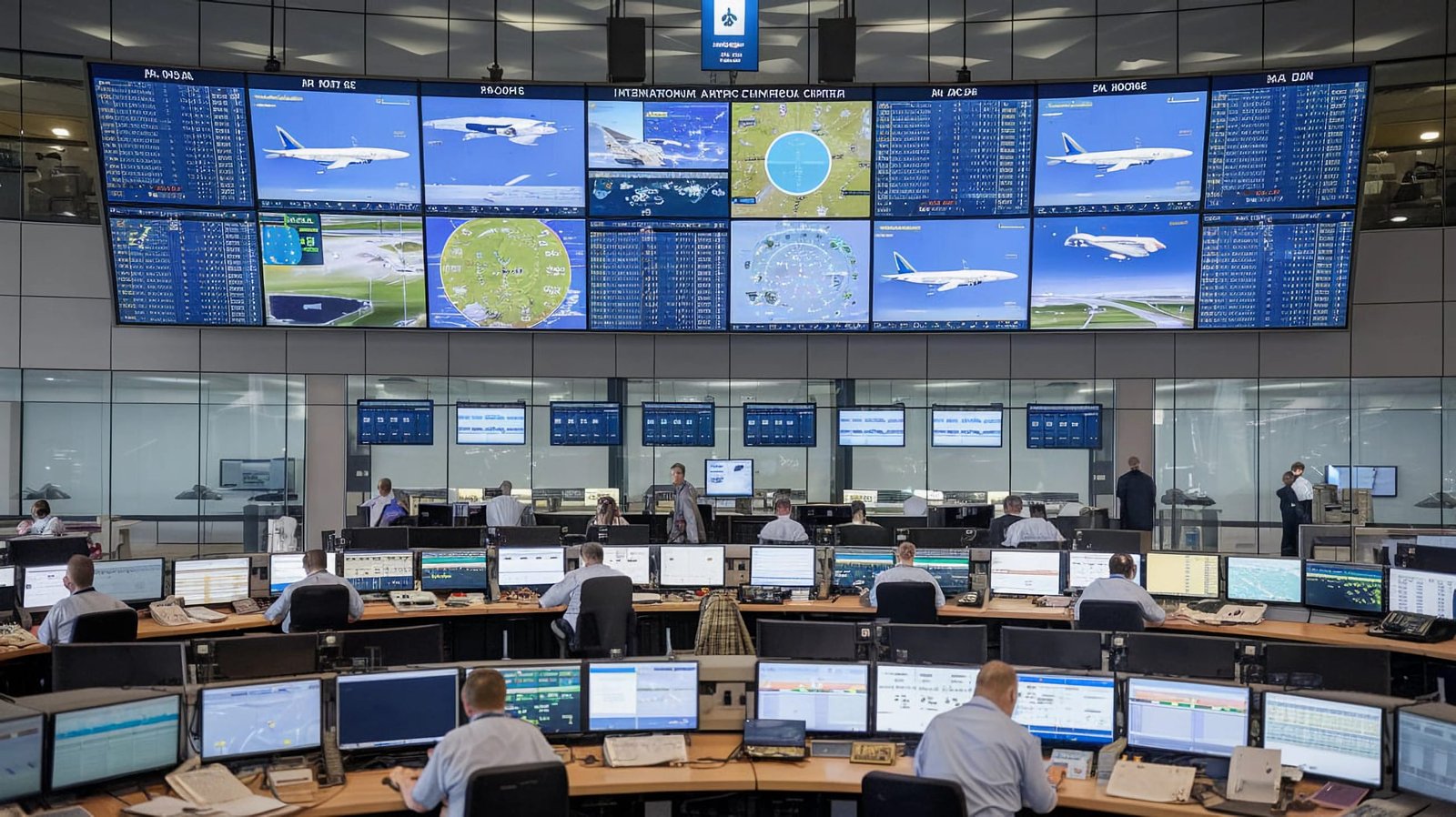
The restrictions revealed a form of power that does not require control of the aircraft, the airport or the destination.
A state can alter the movement between them by governing the space the journey cannot avoid.
Its authority may end at its territorial boundary. The consequences of exercising that authority do not. They travel through schedules, fuel loads, supply chains, connections and entire networks built on the assumption that passage will remain available.
The strategic value of a corridor lies not only in the authority of the state that controls it, but in the dependence of those unable to avoid it.
I. The Sky Is Not Open Space
The sky appears continuous.
International law divides it.
The Convention on International Civil Aviation, signed in Chicago in 1944, recognised the complete and exclusive sovereignty of every state over the airspace above its territory. An aircraft travelling between countries does not pass through an undivided commons. It crosses a succession of legal spaces governed by separate authorities.
Passage depends on rights created through treaties, bilateral arrangements, standing clearances or specific authorisations. The International Air Services Transit Agreement established a multilateral framework for overflight and technical-landing rights among participating states. Other routes remain governed by bilateral agreements and national permissions.
Once incorporated into everyday operations, these arrangements become almost invisible. Airlines publish schedules months in advance. Passengers purchase journeys as though the space between departure and arrival were permanently available. Flight plans are filed within a system designed to make sovereign permissions appear routine.
Every corridor nevertheless remains supported by legal consent that can be limited, suspended or withdrawn.
That distinction became immediate in Doha. The aircraft remained certified. Qatar Airways retained its operating competence. Destination airports had not withdrawn access. Yet routes that had formed part of the airline's network ceased to be usable because the states beneath them had revoked passage.
Certification determines whether an aircraft and its operator are accepted.
Sovereignty determines whether the route remains available.
The difference is rarely visible while both conditions remain intact. It becomes absolute when an authorised aircraft reaches a corridor it is no longer permitted to cross.
The air above a state may appear empty.
Operationally, it is occupied by authority.
II. Trajectory Sovereignty
In June 2017, the measures imposed on Qatar did more than remove a set of routes from an airline's planning system.
They changed the country's relationship with distance.
Eighteen regional destinations disappeared from the Qatar Airways network. Services continuing toward Europe, Africa and the Americas had to use longer paths through the airspace that remained accessible. Flight times increased. Fuel requirements changed. Connections built around the former geography lost part of their margin.
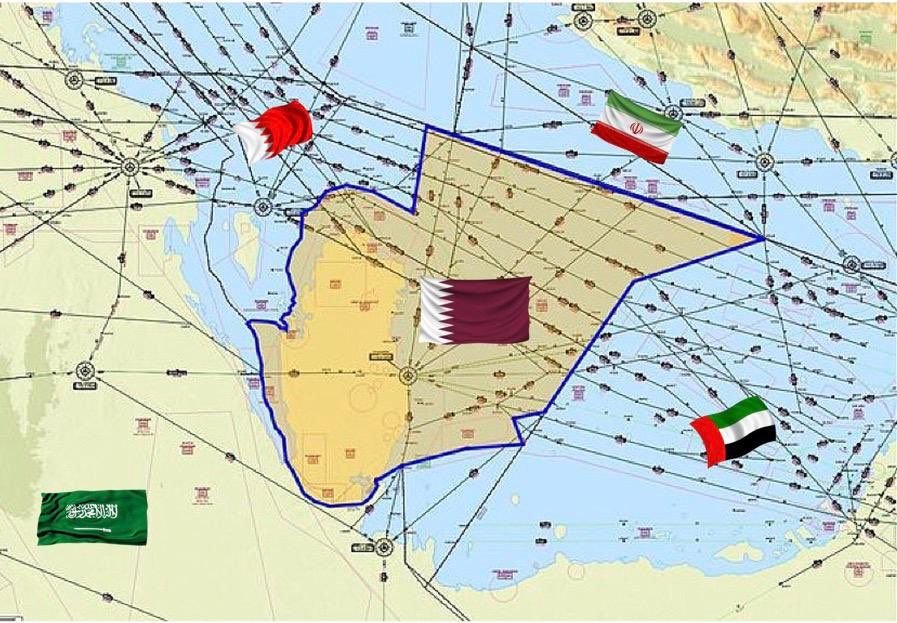
The restrictions exposed how a state can exercise influence over movement without owning the vehicle, controlling its operator or receiving its passengers.
This is Trajectory Sovereignty: the capacity of a state to shape movement by permitting, restricting or redirecting trajectories through the airspace under its control.
It does not evaluate the operator.
It controls the corridor.
The distinction is decisive. Regulatory authorities may determine whether an airline is safe enough to enter a market. A state exercising trajectory sovereignty can leave that judgment untouched and still make the journey impossible on its previous terms.
The aircraft may meet every applicable standard. The crew may hold every required licence. Departure and destination may both remain open.
None of those conditions preserves the space between them.
Once passage is withdrawn, the political decision enters the aircraft through operational consequences. A longer route requires more fuel. Additional fuel increases take-off weight and may reduce the payload available for passengers or cargo. Extended flight time affects crew-duty limits, aircraft rotations and onward connections. A departure that remains technically possible may cease to be commercially rational.
For passengers, the sovereign decision is usually encountered indirectly: a cancelled service, a longer flight, a missed connection or a timetable that no longer works as designed.
For the state affected, the consequence is larger. Aviation is not simply a sector through which people travel. For a small, globally connected country, it is part of the architecture through which markets, institutions, labour, cargo and diplomatic reach remain accessible.
Restricting the airspace around Doha therefore constrained more than an airline.
It placed pressure on one of the systems through which Qatar preserved its connection to the world.
The states imposing the restrictions did not cross Qatar's frontier.
They altered what could move beyond it.
III. When One Closure Redraws the Network
The effect of an airspace restriction does not stop at the boundary where it is imposed.
It propagates.
A closed corridor transfers traffic toward the routes that remain. Flights become longer. Aircraft consume more fuel. Navigation and overflight charges may increase along replacement paths even where the underlying tariffs remain unchanged. Crew and fleet schedules designed around one geography must be rebuilt around another.
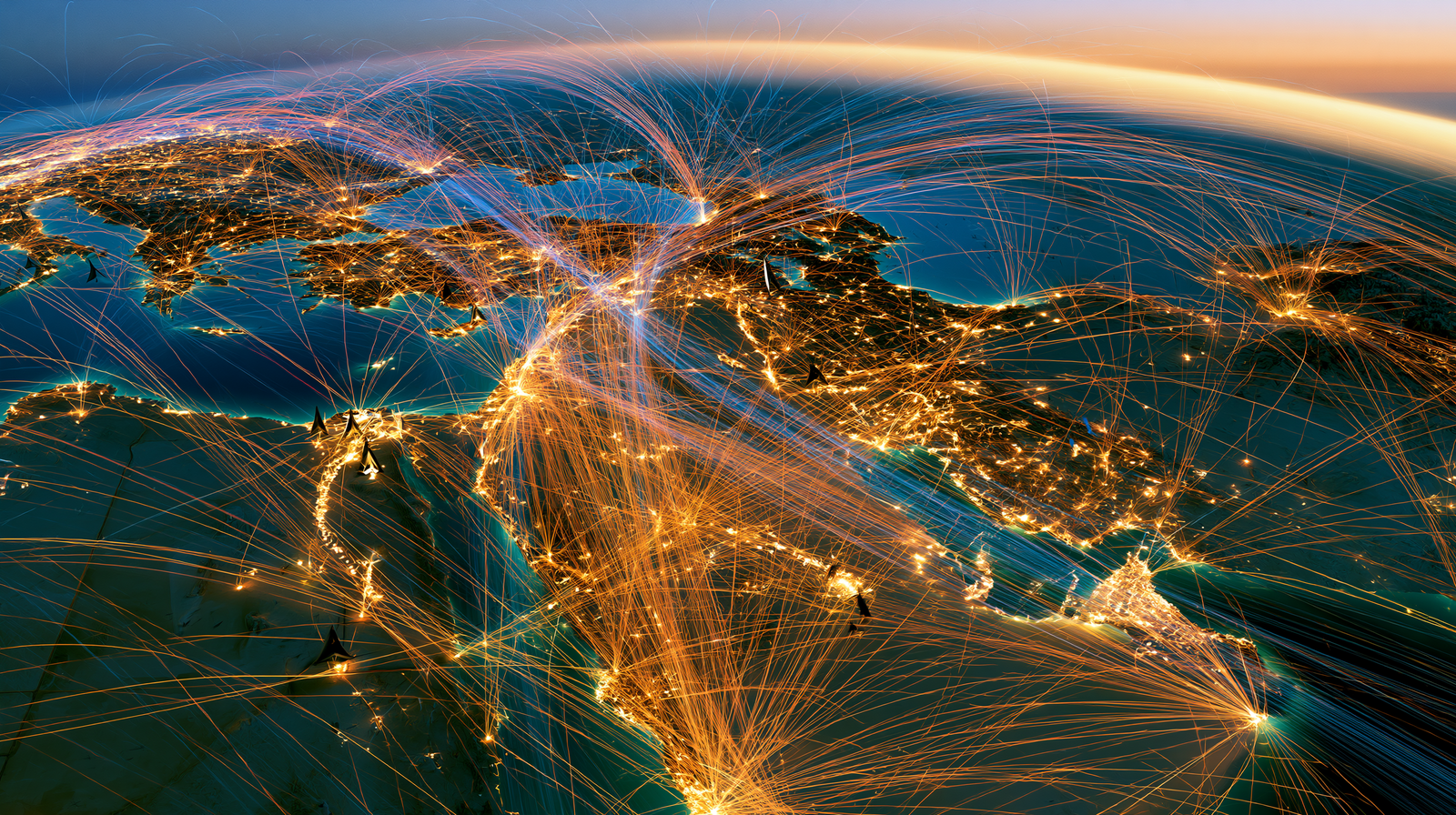
An aircraft arriving late in one city may depart late for another. A crew may no longer have sufficient legal duty time to complete its following sector. A connection built around a narrow transfer window may become unreliable. Cargo that cannot be carried on one flight must wait for another.
A sovereign act becomes a network condition.
This is why the strategic value of airspace cannot be measured only by the traffic directly excluded from it. Its wider significance lies in the number of schedules, corridors and institutions organised around the assumption that it will remain open.
When that assumption fails, geography is reinterpreted in real time.
Traffic is redirected through neighbouring flight information regions, increasing the operational importance of the routes that remain available. Some services continue at higher cost. Others lose frequency, payload or commercial viability.
Nothing in the physical landscape has changed.
The network has changed its reading of it.
This is the second dimension of trajectory sovereignty. It is not merely the power to exclude an aircraft from sovereign space. It is the power to redirect movement across the wider system and alter the relative value of the nodes through which that movement must now pass.
A state does not need to possess a large domestic aviation market to exercise this influence.
It needs to occupy a position the network finds difficult to avoid.
Its power is geographic in origin, legal in form and operational in effect.
Its scale, however, depends on something the state does not control alone: the absence of a workable alternative.
IV. The Price of Dependence
The measures imposed in 2017 revealed the immediate strength of corridor power.
They also revealed its limits.
Qatar Airways lost regional destinations and incurred the cost of longer routings. Fuel efficiency deteriorated on affected services. Network planning became more difficult. A system designed around Doha's position between continents had to function while much of the surrounding regional airspace was closed to its aircraft.
The pressure was substantial because the restrictions acted upon existing dependence.
The routes were valuable precisely because they had become routine. Aircraft schedules, connecting banks and commercial assumptions had all been developed around access that had appeared stable. When that access disappeared, the cost of substitution arrived before the substitute was fully organised.
This is where trajectory sovereignty acquires its greatest force.
It is strongest in the interval between the closure of a corridor and the reliable availability of another.
During that interval, the affected network must either absorb the additional cost of avoidance or reduce the movement it was designed to sustain. The state controlling the corridor does not need to stop the network entirely. It needs only to make continuity more difficult than it was before.
Qatar Airways did not cease operating.
Its network adapted.
Flights were redirected through the airspace that remained open. Relationships with alternative jurisdictions became more important. The airline continued to connect Doha to long-haul destinations, although under more demanding operational conditions.
Qatar also challenged the restrictions through the institutions governing international aviation. The dispute reached the Council of the International Civil Aviation Organization. The states imposing the measures contested the Council's jurisdiction. In July 2020, the International Court of Justice rejected those appeals, allowing the ICAO proceedings to continue under the Chicago Convention and, in the related case, the International Air Services Transit Agreement.
The response was therefore both operational and institutional.
The network found routes around the closure. The state sought remedies within the legal architecture through which passage had originally been organised.
Neither response removed the cost of the restrictions.
Together, they demonstrated that corridor power is not self-sustaining.
Its value depends on continuing dependence.
V. The Paradox of Corridor Power
A state may close the airspace it controls.
It cannot determine what the affected network will become afterward.
Restriction changes behaviour. Airlines develop contingency plans. States deepen relationships with alternative transit jurisdictions. Network planners reconsider the degree of concentration they are willing to accept. Routes that once appeared inefficient acquire strategic value because they preserve movement when the direct corridor disappears.
The power to close a corridor may therefore accelerate the construction of a system designed to avoid it.
This does not make restriction ineffective. The immediate effects can be severe. Costs rise before alternatives mature. Connectivity weakens before schedules are rebuilt. The pressure may be sufficient to achieve political, military or diplomatic aims long before a network can adapt.
But the exercise of trajectory sovereignty contains a structural paradox.
It is most powerful before substitution has occurred. Its repeated use creates the incentive to make substitution possible.
A corridor is strategically valuable not because it exists, but because others cannot afford to bypass it.
Once alternative routes, agreements and operational practices become credible, positional power begins to weaken. The geography remains. The dependence around it changes.
Sovereignty over airspace is therefore more than a legal possession. It is a strategic asset whose value is determined partly outside the state that possesses it.
The strategic value of closure depends on how long the affected network can function without the corridor, how expensive the alternative is and how quickly that alternative can become routine. The authority to close belongs to the state; the durability of its leverage depends on the system confronting it.
Conclusion — The Border Above the Map
On 5 June 2017, Qatar did not lose territory.
Its airport remained open. Its aircraft remained available. The cities connected through Doha remained where they had always been.
What disappeared was the certainty that the space between them would remain accessible.
The restrictions transformed legal sovereignty into operational pressure. Decisions taken outside Qatar entered its schedules, its fuel calculations, its connections and the architecture through which the country remained linked to the world.
The network adapted, but not without cost.
That cost revealed a property of modern power that is easy to overlook while routes remain open.
A state does not need to control the aircraft, the airport or the destination to change the journey between them. It needs only to control a space the journey cannot yet avoid.
But such power lasts only as long as dependence does.
The aircraft had not changed. The destinations had not moved.
Above the unchanged map, sovereignty had altered the distance to the world.
— Curated Sovereignty
Author's Note
Concept Introduced
Trajectory Sovereignty — The capacity of a state to shape movement by permitting, restricting or redirecting trajectories through the airspace under its control. Trajectory sovereignty operates through control of passage rather than the regulatory assessment of an operator. Its strategic value depends on the importance of the affected corridor, the availability of alternative routes and the time and cost required to make those alternatives operational.
Selected Sources
International Civil Aviation Organization
Convention on International Civil Aviation — Doc 7300. Chicago, 7 December 1944. The foundational framework recognising complete and exclusive state sovereignty over territorial airspace. · International Air Services Transit Agreement. Chicago, 7 December 1944. The multilateral framework for the exchange of overflight and technical-landing rights among participating states.
International Court of Justice
Appeal Relating to the Jurisdiction of the ICAO Council under Article 84 of the Convention on International Civil Aviation — Judgment of 14 July 2020. Bahrain, Egypt, Saudi Arabia and United Arab Emirates v. Qatar. · Appeal Relating to the Jurisdiction of the ICAO Council under Article II, Section 2, of the 1944 International Air Services Transit Agreement — Judgment of 14 July 2020. Bahrain, Egypt and United Arab Emirates v. Qatar.
Qatar Airways Group
Sustainability Report 2017–2018 — Documentation of the loss of eighteen destinations, longer routings and increased fuel consumption following the 2017 restrictions. · Sustainability Report 2018–2019 — Further reporting on longer flight times and operational fuel-efficiency measures during the continuing restrictions.
Questions for Future Research
1. Can trajectory sovereignty be measured through the volume of traffic affected, the strategic importance of the corridor and the time and cost required to activate alternative routes?
2. How does trajectory sovereignty interact with regulatory recognition, market access, hub centrality and operational substitutability?
3. Under what conditions does the restriction of airspace create lasting strategic leverage, and when does it accelerate the development of routes that reduce dependence on the corridor being restricted?
4. How do airlines and states price the risk of sovereign airspace restrictions in route design, fleet allocation, bilateral agreements and contingency planning?
5. Does the growing fragmentation of global airspace through conflict, sanctions, security restrictions and diplomatic confrontation represent a structural transformation of international aviation, or a sequence of temporary disruptions?
Curated Sovereignty examines strategic questions whose answers are still emerging.