Aviation · Infrastructure · Institutions
Beyond the Runway
Why the Gulf Is Betting on the Architecture of Flight Itself
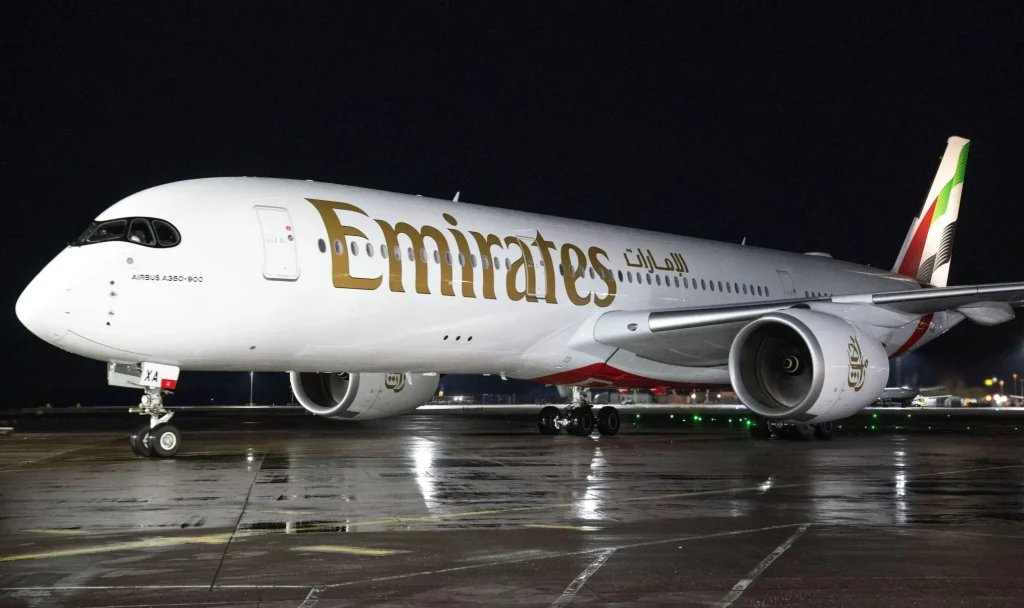
In late November 2024, an Airbus A350 in Emirates livery stood on the tarmac at Dubai International Airport. Delivery was complete. The crew had been trained. The inaugural route had been announced.
Passengers could not board.
Nothing had failed. The aircraft was ready. Commercial flight still had to wait.
When the cabin finally filled on 3 January 2025, travellers saw a new aircraft. They did not see everything that had happened before the door could close.
That distinction reaches far beyond a single aircraft. Modern aviation is usually described through what can be seen: aircraft, airports and airlines. Its continuity depends on what lies behind them.
Beyond the runway begins that invisible architecture.
I. Before the Door Closes
A delivered aircraft is not yet a commercial operation.
Between arrival and departure, the machine must be absorbed into a living system. Its maintenance programme must reflect the manufacturer's requirements, the experience of the operator and the obligations imposed by the airworthiness authority. Engineers must be able to release it safely after maintenance. Pilots must understand its behaviour under ordinary and exceptional conditions. Cabin crews must learn its doors, equipment and emergency procedures. Schedules, ground operations and technical support must be ready to receive it without weakening the reliability of the wider fleet.
Each layer converts technical possibility into repeatable service.
Emirates began preparing for the A350 months before the first aircraft reached Dubai. The airline worked with Airbus and the International Air Transport Association on a type-rating programme for pilots, with an initial cohort scheduled to begin training in July 2024. By October, pilots and hundreds of cabin crew members had already completed aircraft-specific preparation, while further simulator training continued ahead of entry into service.
Preparation extended beyond the cockpit. Cabin crews moved between classroom instruction and practical sessions in a dedicated simulator. A new aircraft type introduces different systems, procedures and responsibilities. All must become familiar before passengers experience them as routine.
Aviation conceals much of its own complexity. When preparation succeeds, the passenger encounters almost none of it. The aircraft arrives at the gate. The cabin opens. The schedule proceeds. What appears effortless is the result of an organisation that has spent months reducing uncertainty around a few hours of movement.
The aircraft is therefore the last visible stage of flight, not its beginning.
Long before the runway, aviation exists in simulators, engineering programmes, manuals, inspections and operating approvals. Different institutions perform the work, often in different places, but their decisions form a single chain. One weak link can delay entry into service, restrict a route or return an otherwise functional aircraft to the ground.
The strategic question is no longer limited to who can purchase the newest aircraft or build the largest terminal. It concerns who can bring aircraft into service, keep them there, and restore them after every arrival.
Flight first enters a shared order.
II. The Shared Order of Flight
An aircraft becomes commercially useful only when others can trust the conditions under which it operates.
Airworthiness certificates, operating approvals and common standards give that trust legal and technical form. A certificate does not make an aircraft safe by declaration. It records the completion of a defined process, assigns responsibility and allows the aircraft to enter an environment governed by rules recognised beyond a single company.
The UAE's General Civil Aviation Authority stands at the centre of this order nationally. Its remit covers operators, maintenance organisations, training bodies and air-navigation services. Such authority matters because commercial aviation cannot rely on trust between companies alone. Airlines, airports and foreign jurisdictions require an institutional basis for recognising that aircraft, crews and organisations meet accepted standards.
The same order continues after take-off.
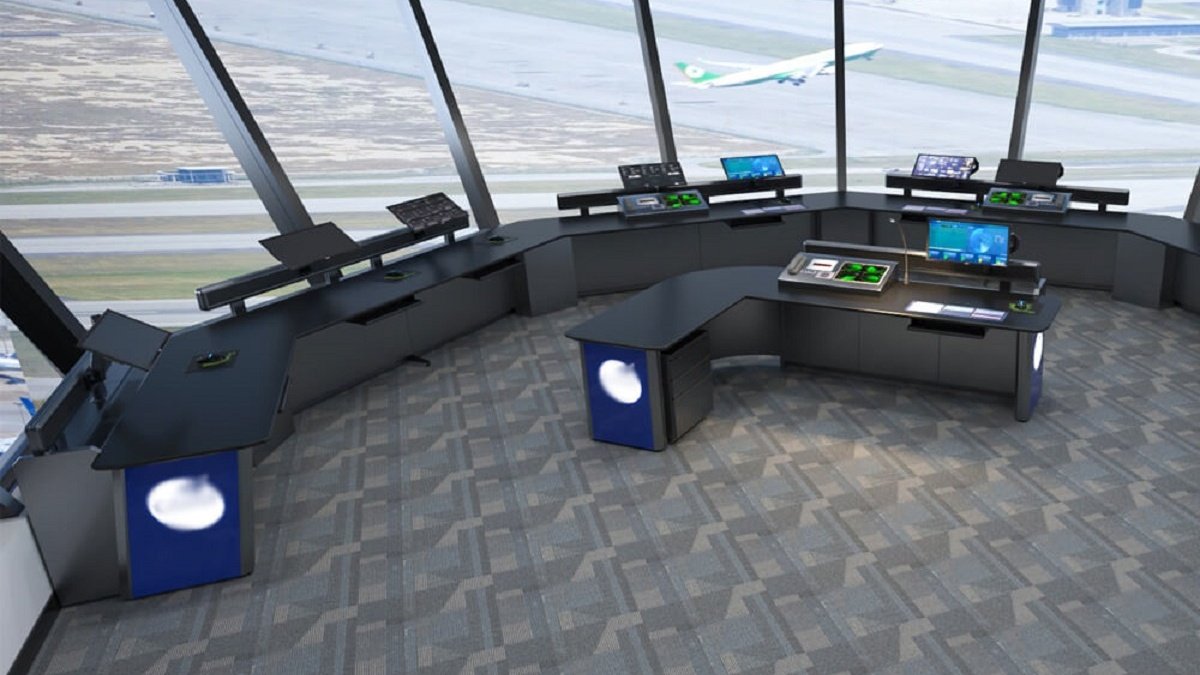
Every flight enters airspace already occupied by other aircraft, routes, weather constraints and competing demands. Safe movement depends on decisions made beyond the cockpit: sequencing traffic, allocating altitude, managing crossings and maintaining the exchange of information through every stage of the journey.
Air-navigation centres organise this complexity. Controllers work with communication, navigation and surveillance systems to convert crowded skies into a predictable operating environment. Their success produces little spectacle. Aircraft cross, climb and descend with a regularity that makes coordination appear natural.
Predictability has been organised.
Commercial aviation is therefore neither a collection of isolated flights nor a simple relationship between a pilot and an aircraft. Each movement relies on institutions whose competence may never become visible to those on board.
That dependence changes the strategic value of aviation investment. An airline can purchase capacity. An airport can add gates. Regulation, air-navigation capability and technical recognition take longer to build because their value rests on accumulated experience, consistent judgement and confidence earned across repeated operations.
The Gulf's aviation success has often been measured through fleet orders, passenger volumes and airport expansion. Those indicators describe the visible scale of the system. Institutional depth provides the more consequential measure: whether the region can authorise, coordinate and supervise the movement it attracts.
Without such capability, expansion deepens dependence. More aircraft increase demand for foreign approvals, imported expertise and institutions located elsewhere. Strong domestic capacity produces a different effect. Each new aircraft, route and operator adds experience to regulators, controllers, trainers and engineers whose knowledge remains after the individual flight has ended.
Permission is not a barrier placed before movement. It is the institutional form that allows movement to recur without rebuilding trust before every departure.
The next test begins after landing.
III. The Architecture of Continuity
Aviation does not prove its strength through one successful departure. Its strength appears in the ability to produce the next one.
After an aircraft returns to the gate, technical records are reviewed, faults assessed and components tested or replaced. Engineers determine whether the aircraft can safely return to service, while planners protect the schedule without compromising the standards on which that schedule depends.
The strategic asset is the capacity to restore an aircraft to movement.
Emirates Engineering already provides round-the-clock line and base maintenance from Dubai, supporting the Emirates fleet. Its facilities test, repair and overhaul components, while technical teams manage maintenance programmes under UAE regulatory requirements. The airline's engineering training college develops maintenance personnel through basic and aircraft-type instruction.
In November 2023, Emirates announced a further investment of US$950 million in an engineering complex at Dubai World Central. Planned across more than one million square metres, the facility is intended to support fleet requirements into the 2040s and expand Dubai's capacity for maintenance, repair and overhaul.
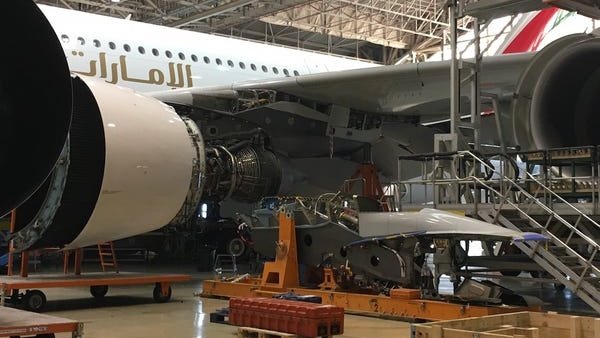
The significance of that investment extends beyond scale. Local maintenance capacity reduces the distance between a technical problem and the expertise required to solve it. Training limits permanent dependence on imported knowledge. Workshops, engineering support and regulatory oversight create an institutional memory built from aircraft types, recurring defects, operating conditions and the practical consequences of technical decisions.
Aviation becomes infrastructure when such knowledge begins to accumulate.
A large airport may process millions of passengers while depending on capabilities located elsewhere. A major airline may operate an advanced fleet while sending critical work across continents. Both models can succeed commercially, but essential parts of continuity remain outside the jurisdiction that relies upon them.
The Gulf's deeper wager is to narrow that distance.
Aircraft and airports remain central to its aviation strategy. Around them, the region is building national oversight, air-navigation services, engineering, maintenance and specialised training. Each performs a distinct function. Their combined value rises when proximity allows knowledge, authority and operational experience to reinforce one another.
An airport connects travellers across borders; an aviation system coordinates the decisions that make those journeys repeatable, predictable and trusted.
That distinction carries a sovereign consequence. A state that hosts traffic participates in movement. A state able to authorise, coordinate and restore that movement gains greater influence over its continuity. Domestic capability reduces exposure to distant expertise and strengthens the system's ability to absorb growth, disruption and technical change.
Complete autonomy remains neither possible nor desirable. Aviation is necessarily global. Aircraft designs, components, standards and routes connect manufacturers, regulators and operators across many jurisdictions.
The strategic aim is capability: sufficient institutional depth to remain an active organiser of the system rather than a passive user of it.
Beyond the runway, sovereignty is expressed through readiness — the capacity to sustain movement after the spectacle of departure has passed.
Conclusion — Where Flight Begins
The Emirates A350 entered commercial service and became part of the ordinary rhythm of the network. Passengers boarded in Dubai, crossed continents and arrived in Edinburgh. The long preparation behind the first departure disappeared into routine.
That disappearance was the achievement.
The Gulf is no longer investing in aircraft and airports alone. The region is also building the institutions that authorise movement, coordinate it through crowded skies and return aircraft safely to service after every arrival. These capabilities attract less attention than a new terminal or a record order, but they determine whether expansion becomes a durable system or remains dependent on structures built elsewhere.
Aviation will continue to be represented by what rises into the sky. Its continuity will depend on what remains on the ground: regulators, controllers, engineers, instructors and institutions whose work is complete only when it is no longer noticed.
The future of flight will remain visible above the runway. Much of the power shaping it will be built before it.
— Curated Sovereignty
Author's Note
Selected Sources
Emirates
Emirates Takes Delivery of Its First A350 — 2024. Official record of the first aircraft's delivery on 25 November 2024 and its planned entry into commercial service. · Emirates Crew Trained to Be Future-Fit and A350-Ready — 2024. Official account of pilot and cabin-crew preparation. · Emirates, IATA and Airbus Launch an Enhanced A350 Type-Rating Course — 2024. Documentation of the joint training programme. · The Emirates A350 Officially Takes Flight to Edinburgh — 2025. Official account of the aircraft's first commercial service. · Emirates to Build New US$950 Million Engineering Facility — 2023. Official announcement of the planned engineering complex at Dubai World Central.
Emirates Engineering
Aircraft Maintenance — Overview of line and base maintenance support provided in Dubai and across the airline's outstation network. · Engineering Technical Services — Official description of fleet maintenance programmes and technical support under UAE regulatory requirements. · Emirates Engineering Training College — Overview of basic and aircraft-type maintenance training.
UAE General Civil Aviation Authority
General Civil Aviation Authority — Official description of the GCAA's federal role in overseeing and regulating aviation activity in the UAE. · Sheikh Zayed Air Navigation Centre — Institutional information on the UAE's air-navigation and air-traffic-management capabilities.
Questions for Future Research
How can the institutional depth of an aviation system be measured beyond passenger volumes, fleet size and airport capacity?
Which capabilities most reduce an aviation jurisdiction's dependence on technical and regulatory institutions located abroad?
How does the concentration of regulation, training, air-navigation services and maintenance affect resilience during disruption?
At what point does aviation infrastructure become a source of sovereign influence rather than a supporting service for airlines?
Can rapidly expanding aviation systems preserve regulatory independence and technical depth at the same pace as operational growth?
Curated Sovereignty examines strategic questions whose answers are still emerging.