Energy · Infrastructure · Dependence
The Geography of Dependence
Why Some Alternatives Exist Only on the Map
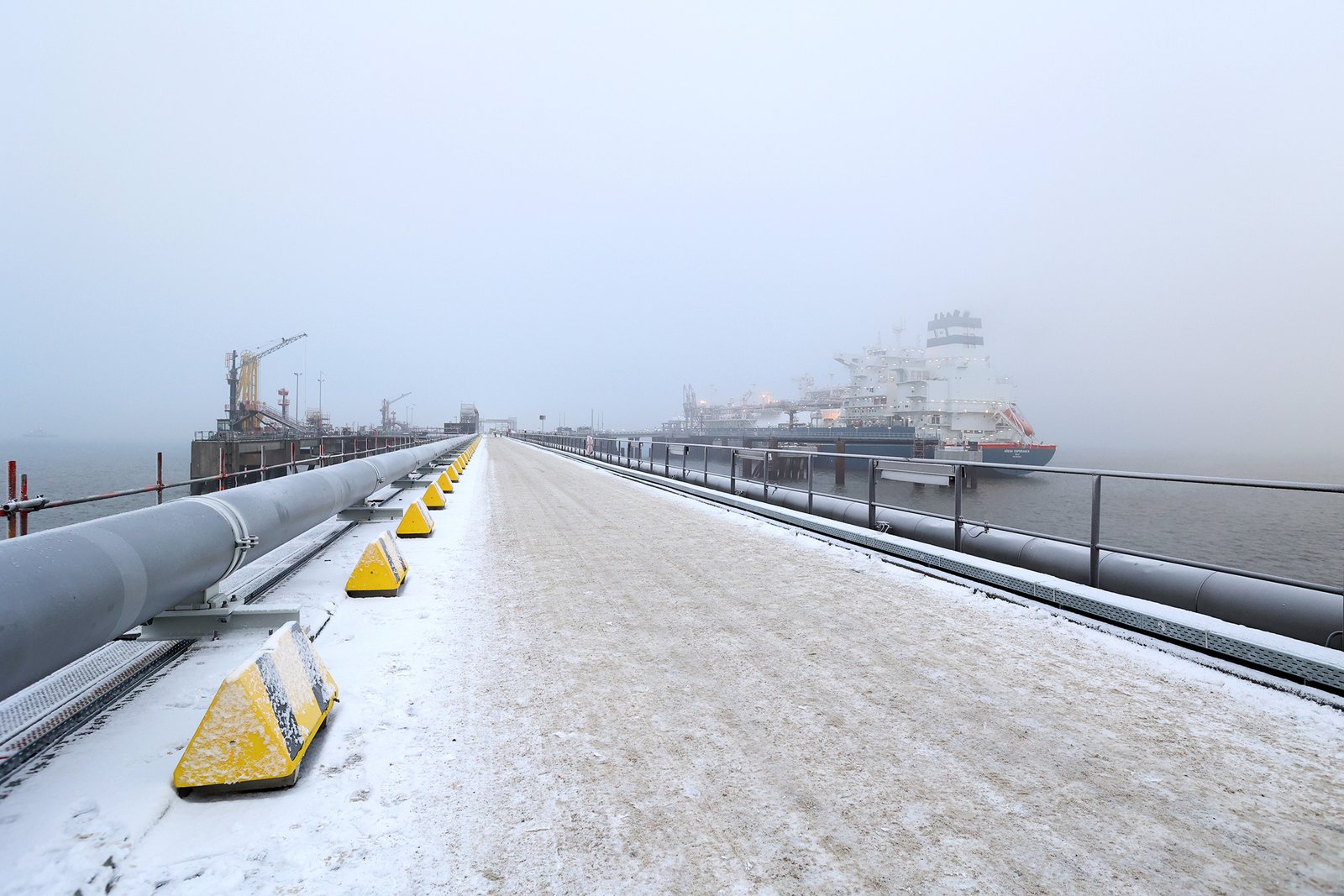
On the morning of 21 December 2022, a small group of people on Germany's North Sea coast waited to see whether a newly built connection would work.
The vessel had arrived six days earlier. The pipeline leading inland had been completed. What remained uncertain was whether the two could operate as one system.
The supply route on which the country had relied for decades had largely disappeared before winter.
That morning, the first gas began to move from the vessel into the network.
The connection had worked.
Germany had the coastline, the purchasing power and access to global markets.
Until that morning, it had lacked the infrastructure connecting them.
The map had always suggested an alternative.
The system had not.
I. The Alternative That Could Not Arrive
The gas entering the network at Wilhelmshaven had been available on global markets for months.
Germany possessed the financial resources to purchase it. Specialised vessels could transport it. Terminals in neighbouring countries already received liquefied natural gas, and part of that supply could move through the European network into Germany.
The difficulty was not absolute access.
It was replacement.
Gas entering through Dutch or Belgian terminals still had to pass through infrastructure with finite capacity. Those networks had been designed around earlier patterns of supply. Their pipelines served several countries, many of which were responding to the same disruption and competing for the same import capacity.
Terminal slots were limited. Connections between coastal entry points and German industrial centres could carry only so much. The direction of the network, the location of consumption and the capacity available at each interface constrained how rapidly additional volumes could move.
Germany could receive gas through neighbouring systems. It could not assume that those routes could replace the lost volumes.
A resource may be present in the market while remaining only partially available to the system that requires it.
The distinction matters because markets and infrastructures perform different functions. Markets determine whether a resource can be purchased. Infrastructures determine whether it can arrive, in sufficient volume, where it is needed.
Germany was connected to the European gas market. It was constrained by the routes through which that market could reach its economy.
Market availability and system availability were not the same condition.
II. Dependence Is a Property of the System
The German gas crisis is often described as a failure of diversification.
The description is not wrong. For years, a significant part of the country's energy system had become concentrated around one source of supply and a limited number of east–west pipeline corridors.
Yet concentration at the source was only part of the exposure.
Dependence is also measured by the distance between the loss of one route and the operational availability of another.
Several suppliers may rely on the same corridor. Several corridors may converge on the same terminal. Several terminals may remain inaccessible to the network that needs them. What appears diversified at one level may remain concentrated at another.
A system therefore cannot be assessed only by counting producers.
It must also be examined through the routes that carry supply, the interfaces that receive and transform it, the networks that distribute it and the institutions that permit those elements to operate together.
This leads to a more demanding test: operational substitutability.
Operational substitutability is the capacity of an alternative source, route or interface to perform the required function at the necessary scale and under prevailing operational constraints.
Another supplier is of limited value if its production cannot be received. A second port does not provide redundancy if the inland network cannot absorb the volume. A parallel corridor may offer little protection if it depends on the same terminal, standard, permission or operating system as the route it is meant to replace.
The distinction separates visible alternatives from usable ones.
Germany's dependence had been embedded across an entire architecture: pipelines, storage facilities, contracts, regulatory approvals, industrial consumption patterns and network design. Each element had evolved around a particular direction of supply.
When that direction changed, the system could not immediately reorganise itself around another.
Its vulnerability did not reside in a single agreement or pipeline. It resided in the accumulated alignment of many systems around the same assumption.
A system is diversified only when disruption in one part does not prevent the others from performing the function that has been lost.
III. How the Map Conceals the System
Germany's lack of a domestic LNG import terminal before 2022 was not simply an omission.
For years, the existing arrangement had appeared economically coherent.
Pipeline gas arrived in large and regular volumes. Much of the infrastructure required to transport it already existed. Long-term contracts reduced uncertainty. Industrial users had organised production around the availability and price of that supply.
Under those conditions, an LNG terminal appeared expensive and potentially underused.
It would have required capital for infrastructure that the existing system did not seem to need. Its commercial value would have remained difficult to justify while pipeline supply continued to perform reliably.
The decision not to build such capacity was therefore reinforced each year by the apparent success of the system already in place.
What later appeared as strategic dependence had begun as repeated economic optimisation.
This is how efficiency hardens into geography.
A route becomes reliable. Investment follows it. Industrial activity adapts to it. Contracts lengthen. Alternative infrastructure appears redundant. Over time, the system becomes more efficient within its established pattern and less capable of operating outside it.
The physical route begins to shape decisions that extend far beyond transport.
Pipelines influence where capacity is built, where storage is located, how networks are configured and which future investments appear rational. They do not merely carry energy. They organise expectations around the continuation of the same flow.
A conventional map conceals much of this architecture.
It can show Germany's coastline, the location of neighbouring ports and the proximity of international shipping lanes. It can trace pipelines and mark terminals. It cannot easily show whether capacity is already reserved, whether the network can reverse direction, whether a terminal is compatible with the required system or how long regulatory and operating procedures will take.
Maps represent space more easily than they represent permission, capacity, compatibility or time.
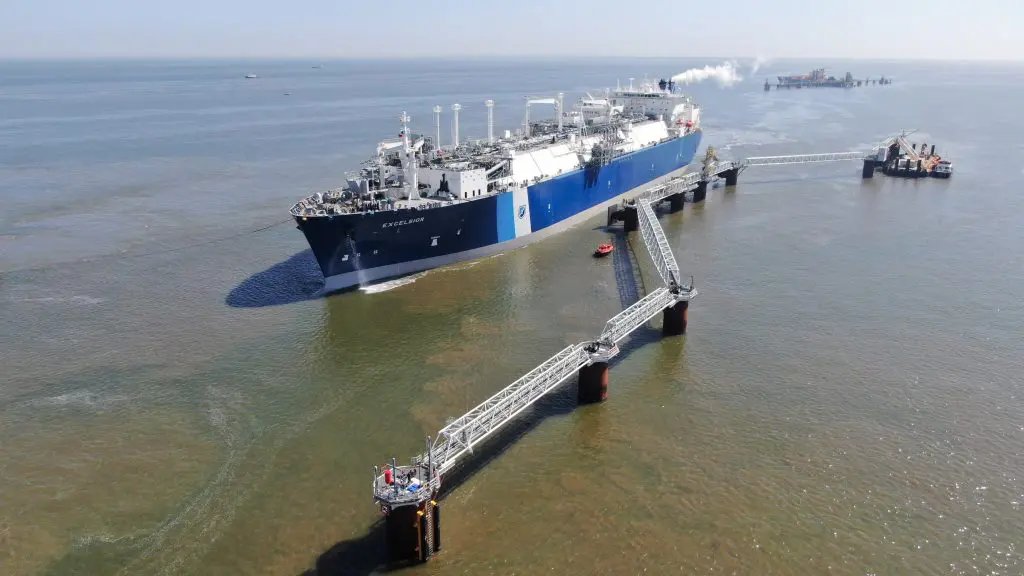
Germany's coast provided geographical access to the global LNG market. It did not provide the receiving and network capacity required to convert that access into supply.
The missing element was the interface.
Without it, proximity could not be converted into supply.
IV. The Emergency Did Not Erase the Architecture
The new infrastructure at Wilhelmshaven was brought into operation in less than seven months.
The speed of the project revealed how little time the institutions behind it believed the country could afford to lose.
An alternative can be technically feasible, financially supportable and politically authorised while remaining strategically useless if it becomes operational too late.
The decisive interval is substitution latency: the time between the loss of a critical route and the reliable operational availability of its replacement.
Dependence becomes dangerous when substitution takes longer than the system can continue without what has been lost.
Germany did not simply require another point of entry. It required one before storage, remaining imports and reductions in consumption ceased to provide sufficient protection.
The challenge was therefore temporal as well as physical.
Construction, regulatory approval, terminal preparation, pipeline connection and network integration had to be compressed into the period during which the rest of the system could still absorb the disruption.
Wilhelmshaven reduced that interval.
The terminal entered service. Gas moved into the network. One of the most urgent constraints on the German system began to ease.
The new route, however, did not end dependence. It altered its structure.
LNG widened the range of potential suppliers, but only by inserting Germany into a longer chain of liquefaction capacity, specialised shipping, terminal access and global price competition.
The new architecture reduced concentration at the source while multiplying the interfaces through which continuity had to be preserved.
Continuity now depended on the availability of export terminals, specialised vessels, open maritime routes and accessible import capacity. Global buyers competed for cargoes that could be redirected between regions according to price and demand.
The system gained flexibility, but it also became exposed to conditions distributed across a wider geography.
Germany exchanged one geography of supply for another.
The first was concentrated around fixed pipelines and a dominant direction of flow. The second was more diverse, more mobile and more closely connected to global markets, yet dependent on a longer sequence of infrastructures and decisions beyond national control.
Diversification did not produce independence.
It reduced the consequences of losing a single source by making several sources more operationally reachable.
V. The Geography of Optionality
The architecture revealed at Wilhelmshaven extends beyond energy.
In semiconductor supply chains, several companies may appear capable of supplying the same category of component. Their production may nevertheless depend on a small number of foundries, specialised machines, materials, packaging facilities or qualification processes.
A manufacturer cannot always move an advanced component from one production site to another without redesign, testing and certification. The alternative exists as an industrial possibility before it exists as an operational substitute.
Digital systems present a similar problem.
An organisation may use several services, platforms or data centres while remaining dependent on the same cloud infrastructure, identity provider, network backbone or submarine cable. What appears to be a network of independent nodes may still converge on a small number of shared interfaces.
The same distinction appears in transport. A nearby airport or port may be visible and technically suitable while remaining unavailable because of capacity, operating rights, ground infrastructure or access constraints.
Across energy, transport and technology, the same error recurs: another node is mistaken for another path.
Real optionality requires more than the identification of alternatives.
It requires the construction of the conditions through which those alternatives become usable.
Those conditions may include multiple interfaces, bidirectional networks, compatible standards, reserved capacity, tested procedures and rights of access established before disruption occurs.
They may also require institutions capable of coordinating decisions across systems that are normally managed separately.
Such arrangements often appear inefficient during stable periods.
A terminal that is rarely used, a second supplier that charges more, spare capacity in a network or an alternative operating procedure may seem difficult to justify when the dominant route remains reliable.
Yet redundancy is valuable precisely because it is not fully consumed by ordinary operations.
The architecture that maximises utilisation under stable conditions is not always the architecture that preserves continuity when one of its routes disappears.
Efficiency and resilience become compatible only when alternatives have been integrated before they are needed.
Optionality is not the number of alternatives visible from the system.
It is the number the system can actually reach.
Conclusion — The Distance to an Alternative
The distance between Germany and the global LNG market had never been measured only in nautical miles.
It was also measured in receiving capacity, network connections, regulatory preparation and the time required to make them operational.
While the existing route continued to perform, investment in those capabilities appeared unnecessary. Their absence became visible only when the system was required to function without the architecture around which it had been built.
Wilhelmshaven reduced that distance.
It did not eliminate dependence. It revealed that dependence had never resided only in the source of supply, but in the infrastructure through which any replacement would have to pass.
A system may be surrounded by suppliers, routes and markets and remain unable to reach them when continuity is tested.
The most consequential distance to an alternative is often the one no map records.
— Curated Sovereignty
Author's Note
Concepts Introduced
Operational Substitutability — The capacity of an alternative source, route or interface to perform the required function at the necessary scale and under prevailing operational constraints.
Substitution Latency — The interval between the loss of a critical route and the reliable operational availability of its replacement.
Questions for Future Research
1. Can operational substitutability be measured consistently across different infrastructures and sectors?
2. Which technical, regulatory and institutional factors determine substitution latency?
3. Does the visibility of alternatives lead decision-makers to underestimate operational dependence?
4. At what point does optimisation around a dominant route create more strategic exposure than economic value?
Selected Sources
Uniper
FSRU for Germany's First LNG Terminal Reaches Wilhelmshaven. 15 December 2022. · First German LNG Terminal to Open in Wilhelmshaven. 17 December 2022.
Federal Government of Germany
Speech by Olaf Scholz, Member of the German Bundestag and Chancellor of the Federal Republic of Germany, at the World Economic Forum in Davos. 18 January 2023.
Bundesnetzagentur
Bundesnetzagentur Publishes Gas Supply Figures for 2022. 6 January 2023. · Monitoring Report 2023. 29 November 2023.
European Network of Transmission System Operators for Gas
Winter Supply Outlook 2022/2023. Brussels, October 2022.
International Energy Agency
Gas Market Report, Q1-2023. Paris, 28 February 2023.
U.S. Department of Commerce
Results from Semiconductor Supply Chain Request for Information. 25 January 2022.
Curated Sovereignty examines strategic questions whose answers are still emerging.